Why the Civil War is still visible in Barcelona
Barcelona was one of the most important Republican cities during the Spanish Civil War of 1936–1939. The conflict was not an abstract national struggle happening elsewhere: political revolution, food shortages, aerial bombardment, internal violence and eventually Francoist occupation reshaped daily life here. You can still read that history in bomb shelters, cemeteries, former prisons, public memorials and the urban landscape around Montjuïc and Poble-sec.
This is a difficult subject to reduce to a sightseeing checklist. The most useful approach is to understand a basic timeline first, then visit one or two places where the physical evidence survives. Barcelona's Museu d'Història (MUHBA) and the city's democratic-memory programmes are better authorities than sensational “dark tourism” tours.
A very short timeline: 1936 to 1939
In July 1936, a military uprising against Spain's elected Republican government triggered civil war. In Barcelona, the uprising was defeated locally and the city remained in Republican territory. The following months brought a revolutionary transformation in parts of Catalan society, political violence, collectivisation and intense competition among anti-fascist forces as well as the wider war against the Nationalist rebellion led by General Francisco Franco.
By 1937 and 1938, Barcelona increasingly experienced the pressures of total war: refugees, rationing, political conflict and repeated bombing. Nationalist forces, supported by Fascist Italy and Nazi Germany, used air power against Republican territory. Barcelona's civilian population became a major target. The city fell to Francoist forces on 26 January 1939; the war ended nationally in April.
Barcelona and the new reality of aerial bombing
The air raids are central to understanding the city's wartime experience. MUHBA describes Barcelona as a city subjected to repeated and at times indiscriminate bombing of civilians, a form of warfare that anticipated the mass urban bombing of the Second World War. Attacks came from Italian aviation based in Mallorca as well as other Nationalist air forces.
The March 1938 raids are particularly remembered because Barcelona was bombed repeatedly over roughly three days, creating fear and disruption rather than one isolated strike. The point for visitors is not to memorise a casualty number from a plaque; it is to understand why the city built such an extraordinary network of shelters and why those underground spaces became part of neighbourhood life.
Refugi 307: the strongest physical place to understand civilian experience
MUHBA Refugi 307 in Poble-sec is one of the most important Civil War sites open to visitors. It was excavated largely through the work of local residents and forms nearly 400 metres of tunnels. MUHBA records spaces for toilets, water, an infirmary, children and other practical needs — evidence that sheltering was not a momentary event but a recurring part of life under bombardment.
The city has documented well over a thousand wartime air-raid shelters. Most are not normal visitor attractions. Refugi 307 matters because it preserves both the physical environment and the story of civilian organisation: residents and public authorities creating passive-defence systems, warning networks and shelters under extraordinary pressure.
How to visit Refugi 307
Refugi 307 is on Carrer Nou de la Rambla in Poble-sec, near Montjuïc. The current MUHBA information we checked on 31 August 2026 says general public visits are limited and advance reservation is essential, with scheduled Sunday guided visits including an English session; other times are largely reserved for pre-booked groups. These details can change, so book through MUHBA rather than arriving because an old guide says it is “open daily”.
The site is underground, narrow in places and intrinsically constrained by its historic form. If you have mobility, claustrophobia, respiratory or other access concerns, contact MUHBA before booking. Do not assume a museum ticket implies a conventional modern-gallery environment.
Poble-sec and Montjuïc: where wartime history overlaps
Refugi 307 makes Poble-sec the easiest neighbourhood in which to connect civilian-war history to the present city. Montjuïc above it carries additional layers of political memory: military fortification, execution sites, the cemetery and later memorial landscapes. The hill also hosted the 1929 International Exposition and later the 1992 Olympics, so it compresses very different Barcelona histories into one area.
Do not rush from shelter to monument trying to “cover the war”. Walk the neighbourhood and remember that many shelters were built by residents beneath ordinary streets. The story is about a functioning city adapting to violence, not only about famous political leaders.
Montjuïc Castle: important, but not only for the Civil War
Montjuïc Castle predates the Civil War by centuries and should not be described as a “Civil War castle”. Its military position has been connected to repression and conflict across different periods of Barcelona's history. During and after the Civil War, however, it became especially associated with imprisonment and execution.
One of the most important names connected with the site is Lluís Companys, president of the Generalitat of Catalonia. After exile, arrest by German forces and transfer to Francoist Spain, Companys was executed at Montjuïc in 1940. His death belongs to the dictatorship's repression after the war rather than to the battlefield phase itself — an important chronological distinction.
The end of the war did not end political violence
Barcelona's fall in January 1939 opened a long Francoist dictatorship. Republican institutions were dismantled, political opponents were imprisoned or executed, many residents went into exile, and public use of Catalan language and symbols was heavily repressed in various phases of the regime.
When you see Civil War memory in Barcelona, therefore, it often extends into the post-war dictatorship. Sites connected with prisons, executions, exile and clandestine political culture cannot be understood if the story stops in April 1939.
La Model and the history of imprisonment
The former La Model prison is another important site for understanding twentieth-century repression. Its history spans far more than the Civil War, but the prison became closely linked with political imprisonment under the dictatorship. Today the complex has been repurposed as a memory and civic space, with exhibitions and activities that help place incarceration within Barcelona's broader social history.
If your interest is democratic memory rather than military history, La Model can be more meaningful than visiting a battlefield-style attraction. Check its current programme and opening arrangements before travelling because access depends on scheduled public use and exhibitions.
Bomb scars, plaques and the problem of urban myths
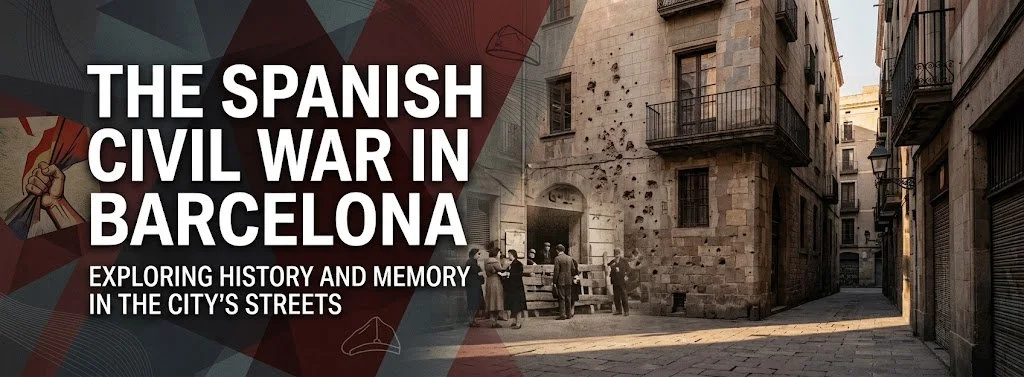
Visitors are often shown marks on walls and told they are bullet holes from the Civil War. Some genuine conflict damage survives, but Barcelona has also accumulated stories that oversimplify or misidentify marks from construction, later damage or different events. Treat confident street-corner claims with caution unless a reliable historical source identifies the site.
A good guide should explain evidence and uncertainty rather than turn every damaged facade into a dramatic anecdote. Public history becomes less useful when it rewards the most cinematic story.
George Orwell's Barcelona: useful, but only one viewpoint
George Orwell's Homage to Catalonia is one of the best-known English-language accounts of revolutionary Barcelona and the May 1937 fighting. It is vivid and valuable, but it is a participant's account from a particular political position and a specific period. Do not use it as the only history of the war, Catalonia or Barcelona.
Reading a short section before walking the Ramblas and old centre can add texture, particularly around the political fragmentation of the Republican side. Pair it with museum interpretation or modern scholarship to avoid treating one witness as an omniscient narrator.
What happened during the May Days of 1937?
In May 1937, tensions among Republican factions erupted into armed confrontation in Barcelona, particularly between anarchist/revolutionary groups and forces aligned with the Catalan and Republican authorities and Communist parties. Street fighting exposed deep political divisions inside the anti-Franco camp.
For a visitor, the lesson is that “Republicans versus Nationalists” is necessary but not sufficient. Republican Barcelona contained competing visions of revolution, state authority and wartime strategy. Those divisions shaped daily life and international interpretations of the conflict.
Families and younger visitors
Refugi 307 can be powerful for older children because it makes civilian experience tangible, but the subject includes bombing, death and political repression. Prepare children for what they will hear rather than presenting the shelter as an underground adventure.
Younger children may get more from a general city-history museum where the Civil War is one part of a wider story. Families should also consider the physical tunnel environment before booking.
Accessibility and respectful visiting
Many memory sites were not built as museums. Underground shelters, cemetery routes, steep Montjuïc paths and historic prison buildings may have access constraints. Verify the exact venue rather than relying on a generic “accessible Barcelona” label.
These are also places associated with civilian trauma and political repression. Avoid staged “war photos”, loud joking in memorial spaces or reducing ideological victims to entertainment. Photography rules vary and should be followed.
How to build a half-day Civil War history route
Start with a pre-booked Refugi 307 visit in Poble-sec. Afterwards, walk toward Montjuïc and choose one additional site: the castle if you want military/political history, the cemetery/memory landscape if you want commemoration, or return toward the city for La Model if prison and dictatorship history matters more.
Do not attempt every site in one day. Civil War history is emotionally and intellectually dense, and Barcelona has many other historical periods worth understanding too.
Useful reading before you go
For a concise primary visitor framework, use MUHBA's material on Refugi 307 and Barcelona's passive defence. Then supplement it with a reputable modern history of the Spanish Civil War and, if you are interested in eyewitness perspective, Orwell's Homage to Catalonia. Remember that memoir and history are different genres.
Our Barcelona history timeline places the war between the earlier industrial/Modernista city and the later dictatorship and democratic transition.
Official sources and related guides
We checked current information from the Museu d'Història de Barcelona (MUHBA) Refugi 307 and Barcelona's democratic-memory resources on 31 August 2026. Current booking arrangements override any timetable quoted by older travel articles.