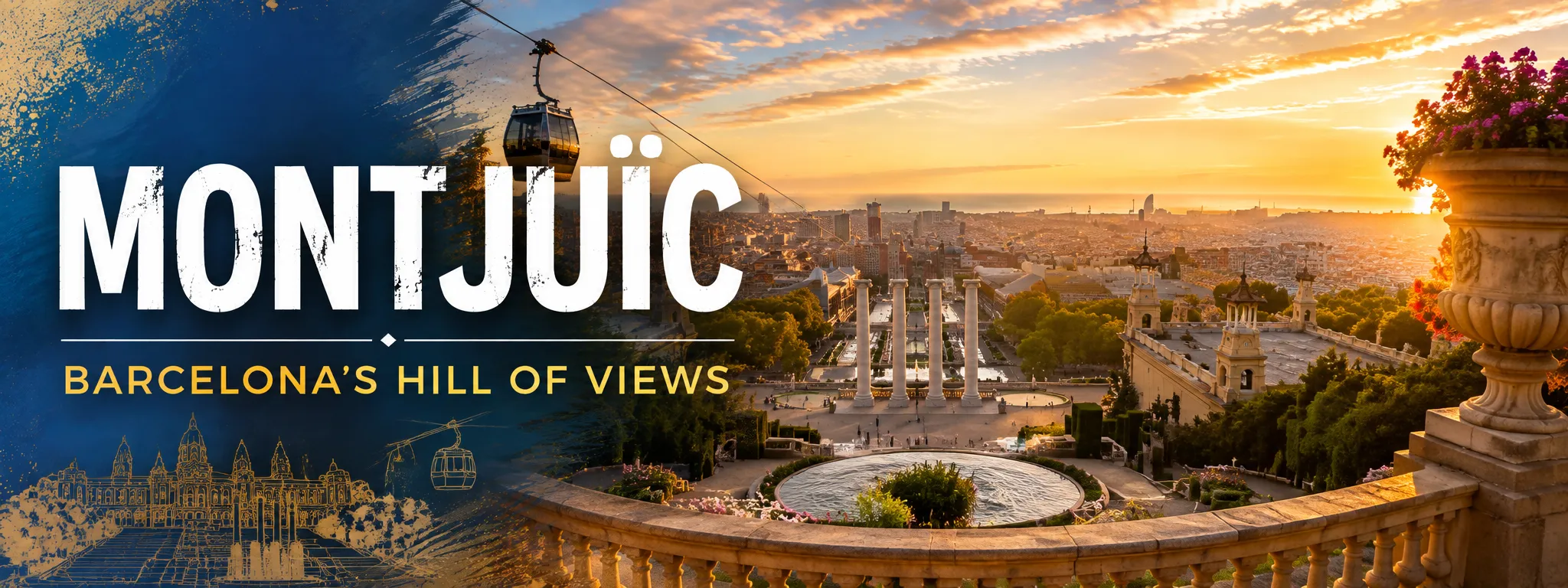
Montjuïc is a hill-sized district, not a normal neighbourhood
Montjuïc works differently from the Gothic Quarter, Gràcia or Eixample. It is a large green hill holding museums, gardens, Olympic venues, viewpoints, the castle and scattered cultural sites, with Poble-sec at its northern foot providing the more recognisable neighbourhood experience. Distances that look short on a map can involve slopes, stairs or circuitous paths, so the best visit is built around a few anchors rather than an attempt to see everything.
Why put Montjuïc on your Barcelona itinerary?
Come for space, views and a concentration of attractions that feel very different from the dense centre. The Museu Nacional d'Art de Catalunya, Fundació Joan Miró, Olympic Ring, gardens and Montjuïc Castle can each anchor half a day. The hill is also useful when you want a quieter rhythm after several days of crowded old-city streets. Families can mix culture with outdoor time; repeat visitors often appreciate it more than first-timers racing between headline Gaudí sights.
The simplest way up: metro plus funicular
TMB's Montjuïc Funicular runs between Paral·lel and Parc de Montjuïc and is integrated into the metro fare system. Paral·lel connects with metro lines L2 and L3. At the upper station you are close to Fundació Joan Miró and can connect to the separate Montjuïc Cable Car. This route is usually easier to understand than trying to walk uphill from Plaça d'Espanya with no plan.
Funicular and cable car are not the same thing
The funicular is public transport up the lower slope; the cable car is a separate aerial ride toward the castle. TMB describes the cable car route as 752 metres from Parc de Montjuïc to the top of the mountain. Buy it for the ride and views, not because it is the only way to reach the castle. If weather, budget or queues make the cable car unattractive, buses and walking routes still connect the hill.
Choose two or three anchors
A culture-heavy visit might pair MNAC with Fundació Joan Miró. A history-and-views visit might combine the castle, Olympic area and gardens. Families may prefer one museum plus playground or garden time. Avoid booking timed entries at opposite ends of the hill with a narrow gap; Montjuïc rewards buffer time. If an event is using the Olympic venues, expect crowd and transport patterns to change.
The Olympic legacy
The 1992 Olympic Games reshaped this part of Barcelona and the Olympic Ring remains one of the hill's defining spaces. Even without entering a venue, the broad plazas and stadium architecture make a useful contrast to the medieval centre and Modernista Eixample. Check current venue calendars if you specifically want access, because concerts and sporting events can affect opening areas and transport.
Gardens and viewpoints are part of the attraction
Do not treat the green spaces as empty gaps between paid sights. Montjuïc contains gardens, terraces and viewpoints where you can slow the day down. In hot weather, shade and water matter; in rain, exposed paths can be less appealing. Comfortable shoes are more important here than in almost any central Barcelona sightseeing zone.
Poble-sec: where the hill meets everyday city life
Poble-sec sits below Montjuïc around Avinguda del Paral·lel and Carrer de Blai. It is useful for meals, drinks and accommodation if you want quick access to the hill without staying in the old city. It also works as a natural finish to a Montjuïc day: descend toward Paral·lel, eat locally, then continue by metro rather than crossing the city hungry after a long museum visit.
Should you stay around Montjuïc or Poble-sec?
Choose Poble-sec if you value local restaurants, the L2/L3 metro connection and proximity to the hill. Choose elsewhere if your trip is dominated by Born, Gothic Quarter or upper Eixample nightlife and you expect to walk home late each night. Around Plaça d'Espanya, transport is convenient for the airport-bus corridor and Fira events, but the feel is more traffic-and-venue oriented than intimate neighbourhood Barcelona.
Accessibility and energy planning
The scale and gradients matter for travellers with limited mobility, small children or low heat tolerance. Use the funicular, buses and taxis strategically rather than assuming every leg should be walked. Check each museum or venue's current accessibility information because lifts, entrances and routes differ. Build downhill segments where possible and leave enough time between sites that a missed connection does not derail the day.
A realistic half-day
Take the metro to Paral·lel and funicular to Parc de Montjuïc. Choose Fundació Joan Miró or another nearby anchor, walk through one garden or viewpoint area, then either continue uphill toward the castle or descend toward the Olympic/MNAC side. Finish in Poble-sec. For a full day, add a second major museum, but keep lunch and rest time in the plan.
The bottom line
Montjuïc is best when you stop treating it as a checklist. Pick a theme, use transport to handle the steepest legs and let the hill's gardens and viewpoints be part of the experience. Poble-sec provides the food-and-neighbourhood counterpoint at the base, making the combination far more satisfying than trying to sprint across every attraction.