
What the Gothic Quarter really is
The Barri Gòtic is the historic core of Barcelona's old city, inside Ciutat Vella. It sits on and around the centre of Roman Barcino, then grew into the civic and religious heart of medieval Barcelona. That layered history is the reason the district feels different from almost anywhere else in the city: a Roman wall can appear beside a medieval palace, a Gothic church can open onto a small residential square, and the city hall and Catalan government still face each other at Plaça de Sant Jaume.
There is an important nuance, though. “Gothic Quarter” does not mean every lane and façade has survived unchanged from the Middle Ages. Barcelona's own heritage material documents how the modern image of the Barri Gòtic was also shaped by restoration and urban interventions in the late 19th and 20th centuries. Casa Padellàs, for example, was physically moved into the Plaça del Rei ensemble as part of the creation of the monumental quarter. Treat the neighbourhood as a real historical palimpsest, not a medieval theme set.
The official Tourism of Barcelona guide places the old Roman centre around today's Carrer del Bisbe and Carrer de la Llibreteria and highlights the Cathedral, Plaça del Rei, the Jewish Quarter and the surviving Temple of Augustus remains as core landmarks. That gives you a much better framework than trying to “see every street.”
A sensible first walk through the quarter
A strong first route starts at the Barcelona Cathedral, cuts behind it to Plaça de Sant Felip Neri, continues through the old Jewish Quarter toward Plaça de Sant Jaume, detours to the Roman Temple of Augustus on Carrer del Paradís, then finishes at Plaça del Rei. If you still have energy, continue west to Santa Maria del Pi and south toward Plaça Reial. It is compact on a map, but the streets are deliberately worth taking slowly.
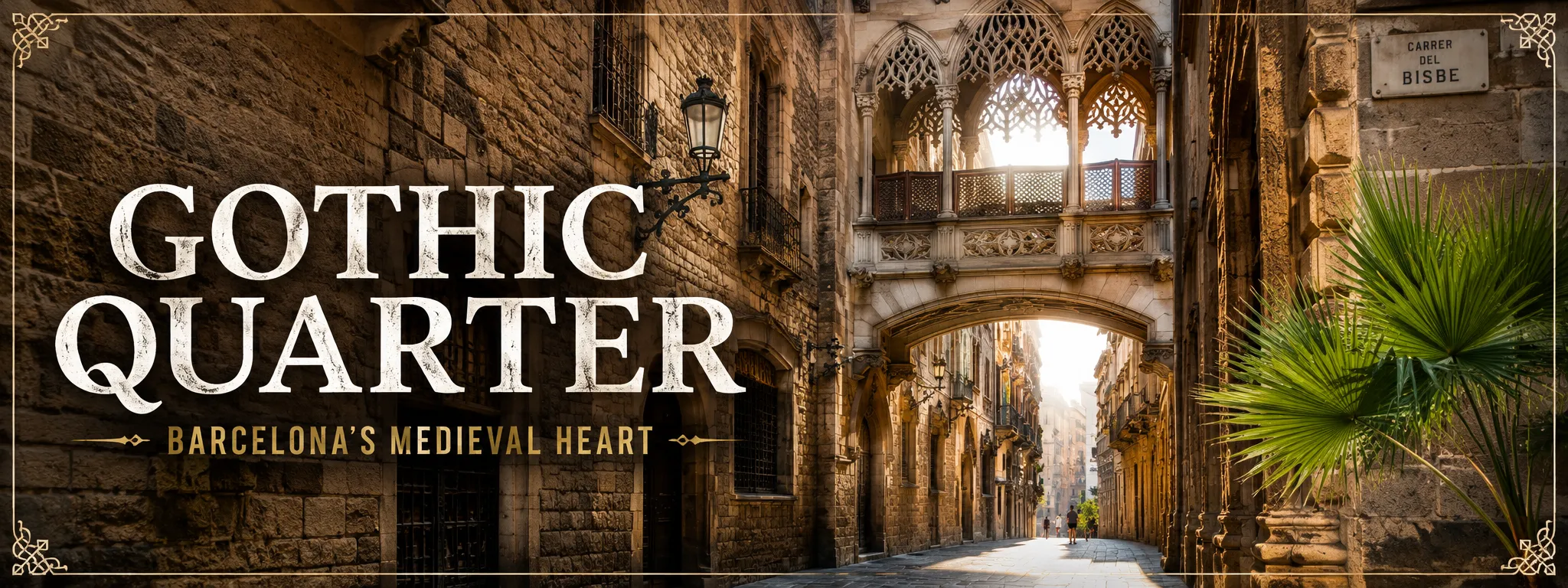
This sequence avoids the common mistake of treating Carrer del Bisbe — the photogenic lane between the Cathedral area and Plaça de Sant Jaume — as the whole neighbourhood. The most rewarding stops are often one or two turns away from the busiest walking line. Use our Barcelona map for orientation, but expect to navigate by landmarks rather than by a perfectly straight route.
Allow two to three hours for an unhurried outdoor circuit. Add more time if you enter the Cathedral or MUHBA's archaeological spaces. If you only have an hour, prioritise the Cathedral exterior, Temple of Augustus area, Plaça de Sant Jaume, Plaça del Rei and one quieter square rather than racing through every named attraction.
Barcelona Cathedral: worth going inside?
Yes, if you have time and want more than a façade photo. The Cathedral's visitor route includes the main floor and cloister, the roof, choir, Chapter Hall and other spaces. As checked on 30 August 2026, the Cathedral publishes cultural-visit hours of 09:30–18:30 on weekdays (last access 17:45), 09:30–17:15 on Saturdays and religious-festival vigils (last access 16:30), and 14:00–17:00 on Sundays and religious festivals (last access 16:30). The published individual tourist ticket is €16. These are exactly the sort of details that can change, so confirm them on the official Cathedral visitor page before building a day around them.
The cloister is Gothic, largely 14th–15th century, while its internal doorway preserves Romanesque elements. The roof is useful for understanding how tightly the old city is packed. Visitors with reduced mobility should note that the Cathedral identifies the Santa Eulàlia gate on Carrer del Bisbe as an accessible entrance; ask staff about the practical route for the spaces you want to see because historic buildings inevitably have constraints.
If your Barcelona trip is heavily architecture-focused, pair this visit with our Sagrada Família guide and Gaudí & Modernisme guide. They show almost opposite ends of the city's architectural story.
Roman Barcino and Plaça del Rei
The Gothic Quarter makes more sense once you realise medieval Barcelona grew directly over Roman Barcino. The official city history material and Tourism of Barcelona both point visitors to surviving Roman wall sections, the Temple of Augustus remains, and the archaeology beneath Plaça del Rei. The temple columns are easy to miss because they are embedded in the modern street fabric near Plaça de Sant Jaume rather than standing in an open archaeological park.
Plaça del Rei is the best single place to understand the transition from Roman to medieval Barcelona. The square is framed by the Palau Reial Major and related historic buildings, while MUHBA's archaeological route descends below street level into thousands of square metres of remains from ancient and early-medieval Barcelona. If history is a major reason you came, make this your paid museum stop rather than trying to cram in several small interiors.
Read our Barcelona history timeline before or after the visit. A little context turns what can look like attractive old stone into a coherent story about how the city kept rebuilding itself on the same ground.
El Call: Barcelona's medieval Jewish Quarter
Near Plaça de Sant Jaume, a network of small streets preserves the urban memory of El Call, Barcelona's medieval Jewish quarter. Tourism of Barcelona identifies it as an integral part of the Gothic Quarter's history, and city heritage material stresses that traces of Jewish Barcelona survive in a landscape that was later altered, reused and reinterpreted.
This is a place where restraint matters. Do not reduce it to a picturesque alley photo. Read the interpretation available locally, notice street names and surviving fragments, and remember that the quarter's history includes persecution and the violent destruction of the Jewish community in 1391. The value of this part of a Gothic Quarter walk is historical understanding, not a checklist of “hidden gems.”
Plaça Sant Felip Neri: beauty and Civil War memory
Plaça Sant Felip Neri is often described as one of the quarter's most atmospheric squares, but its significance is not decorative. Tourism of Barcelona records that a bombing raid in January 1938 killed 42 people, many of them children, and that damage remains visible on the church façade. The adjacent school still uses the square today.
Visit quietly and do not treat the damaged walls as a novelty backdrop. The square is a useful reminder that the Gothic Quarter contains 20th-century memory as well as Roman and medieval history. If the space is busy with school activity or a local event, give it room rather than trying to force a photograph.
Other stops worth your time
Santa Maria del Pi
This Catalan Gothic basilica was built mainly between 1319 and 1391 and sits by Plaça del Pi and Plaça Sant Josep Oriol. Tourism of Barcelona notes its monumental single nave, large rose window and bell tower. It is a strong alternative if the Cathedral area feels overwhelmingly busy and you want a different religious space within the same district.
Plaça Reial
Plaça Reial sits just off La Rambla on the southern edge of the quarter. Its present form dates from the 19th century, after the former Capuchin convent on the site was demolished. The two distinctive streetlamps beside the fountain were designed by the young Antoni Gaudí and installed in 1879. Today the square is particularly associated with restaurants, bars and nightlife, so the atmosphere changes substantially between morning and late evening.
Plaça de Sant Jaume
This is the civic centre, with Barcelona City Hall facing the Palau de la Generalitat. It is not a museum set: demonstrations, public events and political life can change how the square feels on any given day. That living civic role is part of why it belongs on the route.
When to visit and how to handle the crowds
The Gothic Quarter is one of Barcelona's most visited areas, so quietness is partly a timing problem. Early morning gives you the best chance to notice street details before group tours and day visitors build. Late afternoon can also work once some organised groups have moved on, although the food and nightlife streets then begin to fill.
Instead of chasing a supposedly crowd-free secret lane, use a simple tactic: move one or two streets away from the Cathedral–Carrer del Bisbe–Sant Jaume axis, pause in smaller squares and return to the headline landmarks when the flow eases. Summer and major holiday periods increase pressure, but even on busy days the district is not uniformly packed.
For seasonal trade-offs, weather and major calendar factors, see best time to visit Barcelona. If you dislike dense old-town crowds altogether, compare the Gothic Quarter with Eixample, Gràcia or Poblenou rather than assuming every central neighbourhood feels the same.
Eating and drinking without turning the visit into a restaurant hunt
This is a poor neighbourhood for choosing a meal purely by the view. The most exposed tourist corridors can be convenient, but convenience is not the same as value or quality. Move away from the most obvious sight lines, read a current menu before sitting down, and decide whether you actually want a full meal, a coffee stop or a small tapas break.
Because restaurants change ownership, concept, hours and quality faster than monuments change, we are deliberately not hard-coding a “three restaurants you must visit” list here. Use our Barcelona tapas guide and neighbourhood markets guide for the food culture, then check current venue details close to your travel date.
If you want nightlife, Plaça Reial and the southern lanes are much livelier than the Cathedral/El Call side. If you want a quiet night, that distinction matters when choosing accommodation.
Pickpockets and practical street safety
The Gothic Quarter is busy, pedestrian-heavy and full of distracted visitors — exactly the environment where opportunistic theft is easiest. The Catalan police, Mossos d'Esquadra, advise visitors in tourist areas to keep belongings controlled, carry bags in front, avoid easily accessible wallets and be cautious about unsolicited distractions or offers of help. That advice is more useful than panic about the entire district.
Keep your phone and wallet secured when stopping for photos, watch bags when seated outdoors, and be especially alert where crowds compress around La Rambla, metro entrances and busy squares. If something does go wrong, use the official emergency number 112 for urgent help. Our Barcelona safety and pickpocket guide has a fuller prevention-and-response checklist.
Getting there, walking and accessibility
Jaume I (L4) is the most useful metro station for the eastern/central Gothic Quarter; TMB currently lists Jaume I on Line 4 and marks the station accessible. Liceu (L3) is useful from the La Rambla side, while Catalunya and Urquinaona are practical northern approaches depending on where you start. Check the current TMB network information before travel if lifts or service changes matter to you.
Once inside the quarter, walking is the default. Distances are short, but smooth distance and practical distance are not the same thing: narrow lanes, old paving, delivery activity, kerbs, crowds and occasional steps can slow wheelchairs, mobility aids and prams. If accessibility is central to your trip, combine TMB station information with our accessible Barcelona guide rather than relying on a generic “the old town is walkable” claim.
Do not bother trying to sightsee the core by taxi from stop to stop. Use public transport to reach an edge of the district, then walk a planned loop.
Should you stay in the Gothic Quarter?
Stay here if: you want to walk to old-city sights, enjoy historic streets after day-trippers thin out, and do not mind a dense urban environment. It can be particularly satisfying for a short first visit because you begin each morning in the middle of the historic core.
Choose somewhere else if: you are highly noise-sensitive, want straightforward taxi door access, need consistently step-free routes, or prefer bigger rooms and wider streets. Street character can vary dramatically within a few hundred metres, so the exact block matters more here than a broad “Gothic Quarter hotel” label suggests.
Our where to stay in Barcelona guide compares the Gothic Quarter with Eixample, El Born, Gràcia, the waterfront and quieter residential options. Use that before booking, not after.
Gothic Quarter vs El Born: they are not the same neighbourhood
The old page title bundled “Gothic Quarter & El Born” together, which is convenient geographically but imprecise. Via Laietana is the useful mental dividing line. The Gothic Quarter lies to its west; the area popularly called El Born is to the east, within Sant Pere, Santa Caterina i la Ribera. They share old-city scale and walkability, but they are different neighbourhoods with different landmarks and rhythms.
If your priority is the Cathedral, Roman Barcino, Plaça del Rei, El Call and the densest historic civic core, focus on the Gothic Quarter. If you are more interested in Santa Maria del Mar, the Picasso Museum/Carrer Montcada area, Parc de la Ciutadella access and the Born's bar-and-boutique streets, cross Via Laietana and treat that as a separate part of the day.
How much time to give it
- 60–90 minutes: Cathedral exterior, Carrer del Bisbe, Plaça de Sant Jaume, Temple of Augustus area, Plaça del Rei.
- 2–3 hours: add El Call, Sant Felip Neri, Santa Maria del Pi and time to wander without a fixed route.
- Half day: add a Cathedral interior visit or MUHBA archaeology, a proper food break and a slower southward walk to Plaça Reial.
Do not schedule the Gothic Quarter as a ten-stop race. Its value is the relationship between streets, squares and historical layers. For a wider first-trip structure, use our first time in Barcelona guide and Barcelona itineraries.
Official sources checked
This guide was materially reviewed on 30 August 2026. Changeable visitor details should always be rechecked before travel.