Modernisme is bigger than Gaudí
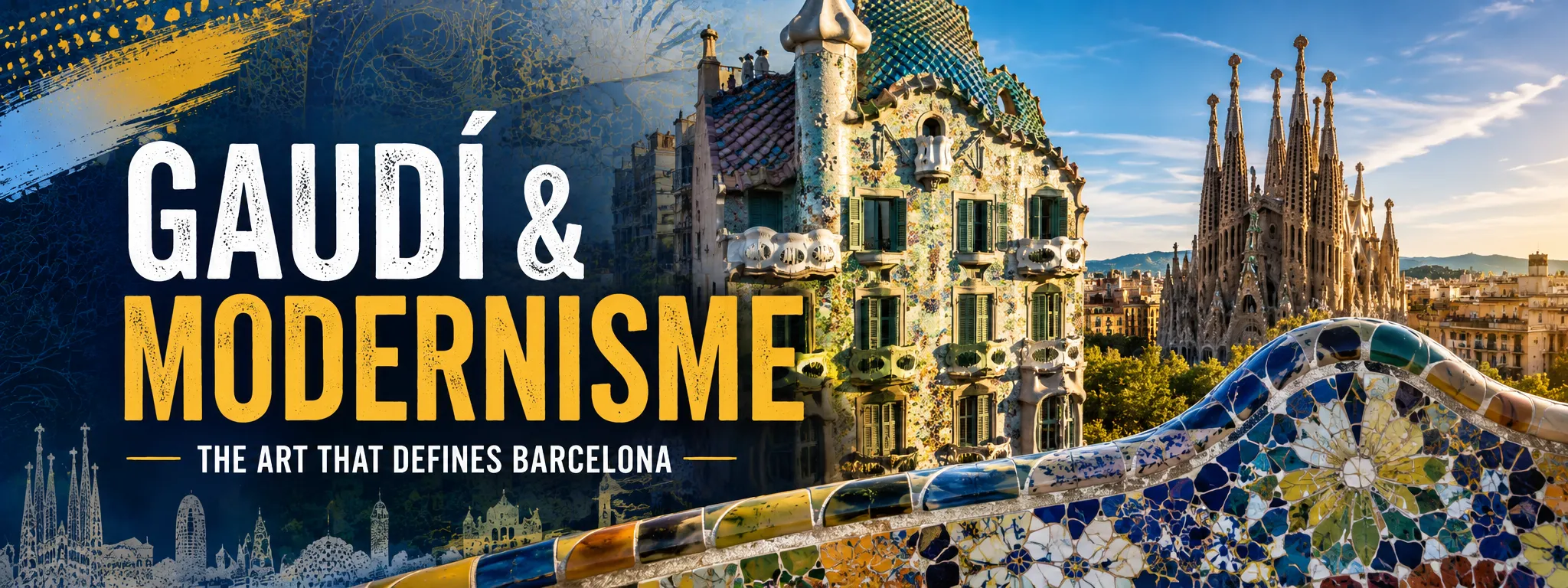
Antoni Gaudí is the name visitors remember, but Barcelona makes more sense when you understand the movement around him. Catalan Modernisme was a broad cultural and artistic movement that flourished around the turn of the twentieth century, during a period of industrial wealth, urban expansion and renewed Catalan cultural identity. Architecture is its most visible legacy, yet the movement also embraced furniture, ironwork, stained glass, ceramics, graphic design, literature and other arts.
The city's official Modernisme Route deliberately presents Gaudí alongside architects such as Lluís Domènech i Montaner and Josep Puig i Cadafalch. That is the right way to look at Barcelona. Gaudí was radically individual, but he was working in a city where clients, craftspeople, engineers and competing architects were all rethinking what a modern Catalan building could be.
Why Barcelona became the capital of Catalan Modernisme
The physical opportunity was the Eixample. As Barcelona expanded beyond its old walls in the nineteenth century, the new grid created entire streets of building plots for an increasingly wealthy bourgeoisie. Homes and commercial buildings became a way to demonstrate status, taste and cultural allegiance. Architects were given facades, stairwells, rooflines and interiors on which to experiment.
That is why Modernisme is not confined to a few ticketed monuments. Walk through Eixample and you see carved stone, floral iron balconies, stained glass, glazed ceramics, elaborate entrance halls and decorative details on buildings that remain apartments, shops or offices. The movement is part of the ordinary streetscape.
Gaudí's place inside the movement
UNESCO describes Gaudí's work as both highly personal and rooted in the cultural currents of Catalan Modernisme, while also drawing on the technical and scientific progress of modern industry. His buildings combine architecture with sculpture, gardens and decorative arts, and his structural experiments anticipated ideas that would influence twentieth-century design.
What separates Gaudí in the visitor's eye is not simply “more decoration”. He developed architecture from geometry, load paths and forms found in nature. Catenary arches, inclined columns, ruled surfaces and branching structures allowed him to create spaces that can feel organic without being structurally arbitrary. The apparent fantasy rests on intense experimentation.
The seven UNESCO-listed Gaudí components
The UNESCO World Heritage property “Works of Antoni Gaudí” consists of seven components in or near Barcelona: Park Güell, Palau Güell, Casa Milà (La Pedrera), Casa Vicens, Gaudí's Nativity façade and crypt at the Sagrada Família, Casa Batlló, and the Crypt of the Colònia Güell. The first group was inscribed in 1984 and the property was extended in 2005.
This list is useful because it shows the range of his work: a park, private houses, a palace, a church project and an industrial-colony crypt. You do not need to visit all seven to understand him, but seeing two different building types is far more illuminating than visiting two similar house interiors back-to-back.
Sagrada Família: Gaudí's religious and structural ambition
The Sagrada Família is the essential Gaudí visit for most first-time travellers, but it is important to distinguish the whole ongoing basilica from the elements actually constructed under Gaudí. UNESCO's inscribed component specifically includes the Nativity façade and crypt. Gaudí devoted the later part of his life to the church, and construction has continued long after his death in 1926.
The best way to visit is to look at structure as much as iconography. Inside, columns branch like trees and distribute loads through a highly ordered system. Outside, compare the densely modelled Nativity façade with later parts of the basilica and think about how a project evolves when multiple generations interpret a design.
Use our Sagrada Família guide for current ticketing, tower and visitor logistics rather than relying on old opening hours embedded in a general architecture article.
Park Güell: architecture, landscape and an abandoned property development
Park Güell is often reduced to the mosaic salamander and the serpentine bench, but the site is more interesting as an urban experiment. Eusebi Güell commissioned Gaudí to create a garden-city-style residential development on the hillside. The commercial housing concept did not succeed as planned, but the infrastructure, landscape architecture and communal spaces became one of Barcelona's defining public environments.
Look at how paths, retaining walls and viaducts sit into the slope rather than treating the monumental zone as an isolated photo set. Gaudí's use of local stone and irregular forms helps the built work appear to grow from the terrain. The site also makes clear that his interests extended well beyond facades.
Casa Batlló and La Pedrera: which house should you visit?
Both are major Passeig de Gràcia landmarks, but they teach different lessons. Casa Batlló is a remodelled existing building with an intensely theatrical facade and interior. La Pedrera (Casa Milà) is a larger apartment building whose undulating stone exterior, courtyards, attic and roof reveal Gaudí's thinking about circulation, light, ventilation and structure at an urban scale.
If you only enter one, choose by interest. Casa Batlló is the stronger choice for immersive colour, craft and visual drama. La Pedrera is often the better choice for understanding the building as a complete system. Our Casa Batlló vs La Pedrera guide goes deeper into the practical comparison.
Casa Vicens: early Gaudí before the familiar visual language fully formed
Casa Vicens is especially useful after you have seen one of Gaudí's later works. Its colourful tiles, geometric surface patterns and Orientalist influences show an architect still developing the language that would later become unmistakably his. It demonstrates why a simple “Gaudí style” label can be misleading: his work changed substantially over time.
Its Gràcia location also lets you build a visit around a neighbourhood rather than a monument-only itinerary. This is a good third Gaudí site for architecture enthusiasts, not a compulsory stop for every first-time visitor.
Palau Güell: a darker urban counterpart
Near La Rambla, Palau Güell is markedly different from the bright, open imagery most visitors associate with Gaudí. Built for his patron Eusebi Güell, it is an urban mansion organised around dramatic interior volume, crafted materials and a rooftop that previews Gaudí's later sculptural treatment of chimneys.
Because it is embedded in the old city rather than Eixample, the building also shows how Gaudí adapted to a tighter urban plot. It pairs naturally with the Raval or Gothic Quarter rather than requiring a separate architecture expedition.
Colònia Güell Crypt: for visitors who want to understand the experiments
The crypt at Colònia Güell, outside central Barcelona, is one of the most revealing Gaudí sites for serious architecture interests. It was part of a larger church project that was never completed. The surviving crypt demonstrates inclined columns, unusual masonry and geometric experimentation that fed into his later work.
It is not the best use of time on a short first trip, but it is a rewarding excursion if you have already seen the central masterpieces and want to understand process rather than simply accumulate landmarks.
Domènech i Montaner: the essential second architect
Lluís Domènech i Montaner is the architect most likely to change a visitor's idea that Modernisme equals Gaudí. His major Barcelona works include the Palau de la Música Catalana and the Hospital de Sant Pau. Both demonstrate Modernisme's integration of structure, decorative arts and symbolism, but with a visual language distinct from Gaudí's.
If you have already booked Sagrada Família, adding Sant Pau is particularly effective because the sites are close enough to combine. You will see two very different answers to the same era's ambition: Gaudí's singular basilica and Domènech i Montaner's humane hospital complex organised as a campus of pavilions.
Puig i Cadafalch and the “Block of Discord”
Josep Puig i Cadafalch adds another strand. Casa Amatller, beside Casa Batlló, is the easiest introduction. That stretch of Passeig de Gràcia is part of the famous Illa de la Discòrdia — often translated as the Block of Discord — where neighbouring buildings by leading Modernista architects display sharply different approaches.
Stand across the street before entering anything. In a few minutes you can compare facades, rooflines, windows, sculpture and ornament and understand that Modernisme was a competitive ecosystem rather than one designer's personal brand.
How to recognise Modernisme while walking
- Integrated craft: architecture, ironwork, stained glass, mosaics, sculpture and furniture designed as one environment.
- Nature as source: floral motifs, organic curves and structures inspired by growth rather than applied as simple decoration.
- Historic references: Gothic, medieval and Catalan traditions reinterpreted for a modern city.
- New materials and industry: traditional craftsmanship mixed with modern structural and production techniques.
- Expressive facades: buildings used as public statements of identity and patronage.
These are clues, not a rigid checklist. One of the pleasures of Eixample is noticing less-famous examples that combine only some of these features.
A self-guided Modernisme walk that does not require ten tickets
Start around Passeig de Gràcia. Compare Casa Batlló, Casa Amatller and nearby facades from the street. Walk to La Pedrera and study its stone frontage and roofline. Continue toward Sagrada Família or take public transport if energy is limited. If time allows, finish at Hospital de Sant Pau.
This gives you a strong survey from public space. Pay to enter one or two buildings rather than every famous house. Modernisme becomes easier to understand when you alternate interiors with streets and neighbourhood context.
How many Gaudí interiors should you book?
For a three- or four-day first trip, Sagrada Família plus either Park Güell or one Passeig de Gràcia house is enough for most travellers. Architecture enthusiasts can add more; casual visitors often reach “ornament fatigue” before they expect it.
Timed tickets also create a logistics problem when overbooked. Three prepaid monuments scattered across the city can turn the day into a race. Anchor one major site in the morning and leave room to explore the surrounding district.
Modernisme with children
The movement's colour, animals, unusual roofs and tactile-looking forms can work well for children, particularly at Park Güell and the more theatrical houses. The challenge is less the subject than the schedule. Long architectural explanations and multiple interiors in one day can become exhausting quickly.
Choose one major interior, add an outdoor site or neighbourhood walk, and leave time for food and a playground. Families with prams should check current lift and route information for historic houses because accessible routes can differ from the standard visitor path.
Accessibility and crowd planning
Many major Modernisme attractions have invested heavily in accessible routes, but protected historic buildings can still involve lifts, alternate entrances, restricted rooftop sections or uneven circulation. Check each venue's current official accessibility page if a particular route is essential.
Crowd management also changes the experience. Early timed entries tend to provide more space to notice details. At free exterior viewpoints such as Passeig de Gràcia, step back across the street rather than joining the crowd pressed against the facade.
Do not confuse Modernisme with all “old Barcelona”
The Gothic Quarter is older in origin, although parts of its present appearance were reshaped in later periods. Eixample is the district most closely associated with Modernista expansion. Medieval churches, Roman archaeology, nineteenth-century industrial architecture and Modernisme overlap across Barcelona, but they are not interchangeable.
Understanding that chronology makes the city richer: visit our Barcelona history timeline and Gothic Quarter guide to put the architecture into sequence.
Official sources and the best next steps
UNESCO's Works of Antoni Gaudí entry is the strongest concise reference for the seven World Heritage components and Gaudí's architectural significance. The Barcelona Modernisme Route, organised by the City Council's Municipal Institute of Urban Landscape and Quality of Life, is the best starting point for seeing the movement beyond Gaudí. Both were checked on 31 August 2026.